Pool Permit in Brevard County, Florida
It depends
Sometimes, depending on the project
Before installing an in-ground pool or spa, or an above-ground pool 24 inches deep or deeper, in unincorporated Brevard County
Issued byBrevard County Planning and Development Department, Building Permits Division
By Mario Bailey, verified against official sources
Quick answer
In unincorporated Brevard County, a Residential Pool permit is required for any in-ground pool or spa, and for above-ground pools with a water depth of 24 inches or more. The application requires county staff review and documentation such as a pool barrier safety affidavit, consistent with Florida's Residential Swimming Pool, Spa and Hot Tub Safety Act requirement for an approved barrier or alarm. This applies only to unincorporated Brevard County; incorporated cities have their own building departments and pool permit rules.
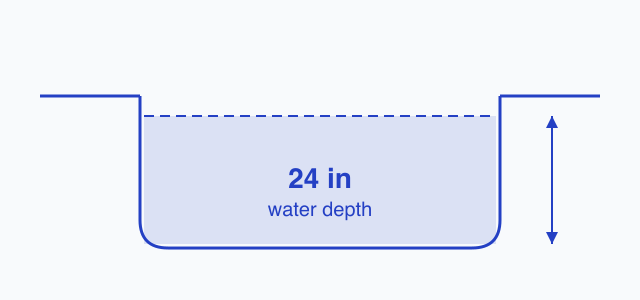
Typical threshold: Permits are issued for in-ground pools and spas, and for above-ground pools with a depth of 24 inches or greater.
Who is pulling this permit?
Apply yourself
Hire it out
Sponsored
Pool builders handle the permit and its safety requirements as part of the job. Comparing a few bids before you sign is the useful next step.
Compare pool builder quotes on Angi
Sponsored link. PermitNotebook may earn a fee if you request quotes through it. Partners never influence our permit data.
When a permit is usually needed
Before installing an in-ground pool or spa, or an above-ground pool 24 inches deep or deeper, in unincorporated Brevard County
What your pool permit must meet in Florida
Florida residential pools are built under the Florida Building Code, Residential, 8th Edition (2023), which the Legislature requires to incorporate the safety-feature and barrier standards of the Residential Swimming Pool Safety Act (Florida Statutes Chapter 515).
- State law requires the Florida Building Code to uniformly implement the pool-safety statutes by including standards for residential swimming pool barriers, pool covers, latching devices, and door and window exit alarms (F.S. 553.73).
- A new residential pool must be built with at least one of five listed safety features, not necessarily a fence: a compliant barrier, an approved safety pool cover, exit alarms on doors and windows with access to the pool, self-closing self-latching doors, or a certified pool alarm (F.S. 515.27).
- If a barrier is used, it must be at least 4 feet high on the outside and may not have gaps, openings, indentations, or structural components that could let a young child crawl under, squeeze through, or climb over it, placed far enough from the water's edge that a child who gets past it does not immediately fall in (F.S. 515.29).
- Pool gates must open outward away from the pool, be self-closing, and have a self-latching device with its release mechanism on the pool side, positioned out of a young child's reach (F.S. 515.29).
- Where a removable mesh safety barrier is used, it must comply with ASTM F2286 and may not be installed on top of an above-ground or on-ground pool (FBC-R, 8th Edition change).
Based on Florida Statutes Chapter 515 (Residential Swimming Pool Safety Act, ss. 515.27, 515.29) as implemented by the Florida Building Code, Residential, 8th Edition (2023), Chapter 45. Read the code. Local amendments can be stricter; confirm the current requirement with your office before you build.
What a pool permit costs in Brevard County
How Brevard County compares in Florida
Across the Florida jurisdictions we have verified, the same threshold runs from 24 to 42, so a project that is exempt here may still need a permit one county over.
| Jurisdiction | Permit needed? | Threshold |
|---|---|---|
| Brevard Countythis page | It depends | Permits are issued for in-ground pools and spas, and for above-ground pools with a depth of 24 inches or greater. |
| Charlotte County | Permit required | This residential pool/spa permit type includes spas, swim spas, and above-ground pools that are 24 inches or greater in depth. |
| Hernando County | It depends | Manufactured pools less than 24 inches deep are exempt from a building permit |
| Lake County | It depends | Storable swimming or wading pools capable of holding water to a maximum depth of 42 inches, or pools with nonmetallic molded polymeric or inflatable fabric walls regardless of dimension, are exempt from a building permit except for non-cord-and-plug electrical work |
| Lee County | It depends | All in-ground pool construction or renovation requires a permit; an above-ground pool requires a permit when its water depth is 24 inches or more. |
| Leon County | Permit required | Applies to private residential swimming pools, hot tubs, or non-portable spas containing water over 24 inches deep. |
| Manatee County | It depends | Swimming pools require a building permit, including above ground pools that exceed 24 inches in height. |
Closest pool permit thresholds outside Florida
Jurisdictions we cover whose limit sits nearest Brevard County's 24 inches.
- Bellevue, Washington, swimming pools over 24 inches deep require a permit with plan review; above-ground pools 24 inches or less may be exempt
- King County, Washington, prefabricated above-ground pools less than 24 inches deep and not exceeding 5000 gallons are exempt; all other pools require a building permit in unincorporated King County
- Pierce County, Washington, Prefabricated swimming pools accessory to a single family residence (Group R-3 occupancy) are exempt if less than 24 inches deep, with no separate gallon volume cap; in-ground pools and pools 24 inches deep or deeper require a building permit. Self-contained spas and hot tubs installed entirely above ground and not connected to the potable water system or a septic or sewer drain are separately exempt regardless of depth.
- Riverside County, California, A prefabricated swimming pool less than 24 inches deep is exempt from a building permit; the department's handout adds that it must be above ground, hold no more than 5,000 gallons, and be at a single-family property
How to apply in Brevard County
In Brevard County, a residential pool permit application covers both construction and safety: a scaled site plan, structural plans for the pool, a barrier plan showing how the pool will be enclosed, and an electrical plan covering bonding and the equipment disconnect.
What most pool permit applications include:
- Pool and spa design and construction fall under the residential code chapter that folds in the swimming pool and spa code, and permit review checks plans against that chapter (IRC R326).
- For Brevard County, the site plan must show pool equipment such as pumps, filters, and heaters set back at least 36 inches from the outside of the required barrier (ISPSC 305.2.9).
- For an in-ground pool, engineered structural plans covering the shell and reinforcing steel, with the responsible structural engineer's license information, are a standard part of the submittal (per official pool submittal checklists).
- For Brevard County, a barrier plan identifying the fence, pool structure, or dwelling wall that will enclose the pool must be submitted and must comply with the code's barrier chapter (ISPSC 305).
- Electrical plans must show the pool's equipotential bonding design, since the shell, perimeter surfaces, and metal fittings within 5 feet of the water must all tie into a common bonding grid (NEC 680.26).
- For Brevard County, the electrical plan must also show a disconnecting means for the pool equipment that is readily accessible and within sight of the equipment (NEC 680.13).
General submittal guidance from 2021 IRC R326 (adopting the ISPSC), ISPSC 2021 Section 305, and NEC 2020 Article 680. Source. Brevard County Planning and Development Department, Building Permits Division sets the exact checklist for Brevard County.
Where to apply in Brevard County:
Brevard County Planning and Development Department, Building Permits Division
- 2725 Judge Fran Jamieson Way, Room A114, Viera, FL 32940
- Phone: (321) 633-2187
- Email: Building.Licensing@BrevardFL.gov
Pool Permit in Brevard County compared with nearby Florida localities
| Locality | Permit needed? | Threshold | What each Florida schedule says | Verified |
|---|---|---|---|---|
| Brevard County | It depends | Permits are issued for in-ground pools and spas, and for above-ground pools with a depth of 24 inches or greater. | ...Pool Permit Application fee table lists a Building Code Review fee of $75.00 for... | |
| Alachua County | Permit required | Any size | Flat fees: swimming pool (in-ground) $380.00, swimming pool (above-ground) $205.00, per... | |
| Broward County | Permit required | Any size | ...per the county's Swimming Pools procedure, each charged the greater of a $125... | |
| Charlotte County | Permit required | This residential pool/spa permit type includes spas, swim spas, and above-ground pools that are 24 inches or greater in depth. | At application: $94 flat fee for above-ground pools or $200 for in-ground pools, plus a... | |
| Clay County | Permit required | Any size | ...208.5), effective January 1, 2025: minimum fee for the first 15,000 gallons $75.00... |
Inspections and closing out your permit
In Brevard County, pool inspections track the concrete pour: the steel and bonding grid are checked before gunite or shotcrete goes in, bonding is checked again before decking is poured, and the permanent barrier and remaining electrical work are checked at final before the pool can be filled and used.
- In Brevard County: before gunite or shotcrete is sprayed, the inspector checks the rebar against the engineered plans and confirms the equipotential bonding wire is stubbed out and tied into the steel, since it will be buried in concrete afterward (NEC 680.26).
- In Brevard County: a bonding inspection separately confirms coping, decking, ladders, handrail cups, and any other metal within 5 feet of the water are tied to the bonding grid, and it must pass before coping is installed (NEC 680.26).
- In Brevard County: a temporary barrier at least 4 feet high must enclose the site from the moment excavation starts until the permanent barrier is finished, and inspectors check for it throughout construction (ISPSC 305.1.1).
- In Brevard County: a pre-plaster inspection confirms the circulation equipment's electrical work is installed and all bonding is complete before the pool's interior finish goes on (NEC 680.26).
- In Brevard County: at final inspection the permanent barrier is checked against the code's requirements and the equipment and cover-mechanism bonding must be complete before the pool can be filled and used (ISPSC 305, NEC 680.26).
Schedule each inspection in advance and pass the final before you use the work or close the permit. Request inspections through the Brevard County permit portal or by phone at (321) 633-2187.
Inspection sequence from NEC 2020 Article 680.26 (equipotential bonding) and ISPSC 2021 Section 305 (barriers). Source. An open permit left un-inspected can surface later in a title search or home sale.
Your Pool Permit checklist for Brevard County
- Confirm the requirement. Sometimes, depending on the project. Typical threshold: Permits are issued for in-ground pools and spas, and for above-ground pools with a depth of 24 inches or greater. Usually needed: Before installing an in-ground pool or spa, or an above-ground pool 24 inches deep or deeper, in unincorporated Brevard County.
- Budget the fee. Brevard's Residential Pool Permit Application fee table lists a Building Code Review fee of $75.00 for the first $1,000 of job value plus $3.25 per $1,000 thereafter, a $25.00 Application Processing Fee, $15.00 Land Development Review, $90.00 Natural Resources Review, and $36.00 Zoning Review, plus a $10.00 Unlicensed Contractor Activity Enforcement fee and state surcharges of 1.5% (BCA) and 1% (FBC). No effective date is shown on the fee table.
- Apply. In Brevard County, a residential pool permit application covers both construction and safety: a scaled site plan, structural plans for the pool, a barrier plan showing how the pool will be enclosed, and an electrical plan covering bonding and the equipment disconnect. Start at the Brevard County permit portal.
- Keep the office details handy. Brevard County Planning and Development Department, Building Permits Division. Phone: (321) 633-2187. Address: 2725 Judge Fran Jamieson Way, Room A114, Viera, FL 32940.
- Plan for inspections. In Brevard County, pool inspections track the concrete pour: the steel and bonding grid are checked before gunite or shotcrete goes in, bonding is checked again before decking is poured, and the permanent barrier and remaining electrical work are checked at final before the pool can be filled and used.
Compiled from the official sources on this page. Last checked .
Frequently asked questions
- Do you need a pool permit in Brevard County?
- In unincorporated Brevard County, a Residential Pool permit is required for any in-ground pool or spa, and for above-ground pools with a water depth of 24 inches or more. The application requires county staff review and documentation such as a pool barrier safety affidavit, consistent with Florida's Residential Swimming Pool, Spa and Hot Tub Safety Act requirement for an approved barrier or alarm. This applies only to unincorporated Brevard County; incorporated cities have their own building departments and pool permit rules. Permits are issued for in-ground pools and spas, and for above-ground pools with a depth of 24 inches or greater. Always confirm with the office before starting.
- How much does a pool permit cost in Brevard County?
- Brevard's Residential Pool Permit Application fee table lists a Building Code Review fee of $75.00 for the first $1,000 of job value plus $3.25 per $1,000 thereafter, a $25.00 Application Processing Fee, $15.00 Land Development Review, $90.00 Natural Resources Review, and $36.00 Zoning Review, plus a $10.00 Unlicensed Contractor Activity Enforcement fee and state surcharges of 1.5% (BCA) and 1% (FBC). No effective date is shown on the fee table. Contact the office for current amounts.
- Where do you apply for a pool permit in Brevard County?
- You can apply through the Brevard County permit portal or contact the Brevard County Planning and Development Department, Building Permits Division directly. The links are listed on this page.
- Can a homeowner pull a pool permit themselves in Brevard County?
- Under Florida law (F.S. 489.103(7)(a)-(c)): Florida lets you pull your own permit as an owner-builder under section 489.103(7), Florida Statutes, which exempts property owners from the contractor licensing law when they act as their own contractor and provide direct, onsite supervision of all work not performed by licensed contractors. The exemption covers building or improving a one-family or two-family residence or a farm outbuilding for your own occupancy or use, and commercial buildings only up to a $75,000 cost, and the property may not be built or improved for sale or lease. If you sell or lease the property within 1 year after completing the work, the law presumes it was built for sale or lease, which violates the exemption. To qualify, you must personally appear and sign the building permit application and sign a state-prescribed disclosure statement acknowledging that you are the party legally and financially responsible for the construction, that you must provide direct, onsite supervision, and that unlicensed people you use must be your own employees, bringing federal tax withholding and workers' compensation obligations. You may not hire an unlicensed person to act as your contractor and may not delegate supervision to anyone who is not licensed for the work being done; if these requirements are violated, the local permitting agency shall withhold final approval, revoke the permit, or pursue unlicensed-activity remedies. A separate narrow branch of the exemption also lets an owner take over and complete a permit on a one-family or two-family residence when the original contractor substantially completed the project. Confirm how Brevard County applies this before you apply.
From the Library
What else needs a permit in Brevard County
Every other permit type we have verified for this jurisdiction, with the rule that applies here.
| Project | Permit needed? | Threshold | Typical fee |
|---|---|---|---|
| Deck Permit | Permit required | Any size | Not published |
| Electrical Permit | It depends | Permits are required for the installation or replacement of electrical wiring, meter cans, and breaker panels; this does not include changing fixtures that do not require moving or changing wiring. | ...Electrical Permit Application fee table lists a Building Code Review fee of $75.00... |
| Fence Permit | It depends | Permit not required for repair or replacement of less than 50% of an existing fence using the same size and material in the same location. | Brevard's Residential Fence Permit Application fee table lists a $25.00 Application... |
| HVAC Permit | Permit required | Any size | ...Permit Application fee table lists a Building Code Review fee of $75.00 for the... |
| Plumbing Permit | It depends | Permits are required for the installation or replacement of water, sewer, or gas piping and systems; this does not include changing like-for-like water heaters or fixtures such as sinks. | ...Plumbing Permit Application fee table lists a Building Code Review fee of $75.00... |
| Roof Replacement Permit | Permit required | Any size | ...Reroof Permit Application fee table lists a Building Code Review fee of $75.00 for... |
| Shed Permit | It depends | A permit is required for an accessory structure (shed) over 100 square feet. | ...permit category, whose fee table lists a Building Code Review fee of $75.00 for the... |
| Solar Permit | Permit required | Any size | ...Permit Application fee table lists a Building Code Review fee of $75.00 for the... |
Pool Permit in other Florida localities
Everything above, sourced
Code references
National and state model-code sections the general guidance on this page is drawn from. They are not Brevard County documents; the office above sets the local rules.
How this pool permit page for Brevard County was verified. 2 official sources: brevardfl.gov, brevardfl.gov. Last checked by Mario Bailey, not confirmed with Brevard County Planning and Development Department, Building Permits Division. Rules change; confirm before you build. How we verify.
Last checked: Report an error on this page